

Registration in an offshore jurisdiction, ties to a crypto project whose token has already lost more than 90% of its value, and the absence of a serious license — all of this is a clear sign that we are dealing with yet another scam rather than a proven and reliable brokerage company. What is wrong with Mazi Finance? You will find out in today’s review. Although the firm promises the best conditions and various advantages, it is not worth believing in these claims.
The official Mazi Finance website follows the standard pattern we see with dozens of offshore “brokers”. The top menu includes several sections: Home, About Us, Trading, Services, Help, and Log In/Registration. Nothing special here — a typical structure that can easily be assembled using any ready-made template.
The homepage lists supposed key advantages: spreads from 0.0 pips, over 500 instruments, leverage up to 1:400, instant execution, and access to MetaTrader 5. At the bottom of the page, there is a block with “legal information”, mentioning MaziMatic Financial Services LTD and registration in the offshore jurisdiction of Saint Lucia. This looks more like a formality for the sake of appearances: no office address, no phone numbers, no real data on the founders.

The website design itself cannot be called unique or professional. Light purple and white tones dominate, with lots of identical icons and images clearly taken from free stock libraries. Everything looks templated, as if the site was hastily put together with a website builder. A quick comparison with reputable brokers such as Interactive Brokers or IC Markets is enough — their interfaces are clean, stylish, easy to navigate, and packed with functionality. With Mazi Finance, it is the opposite: the appearance is made only to “create the illusion of a broker”.
Technical flaws are also obvious at Mazi Finance. The most striking example is the FAQ section. It contains only six questions, but in every case, the exact same answer is provided. It feels like the text was simply copy-pasted with Ctrl+C/Ctrl+V without even being checked. This demonstrates the level of “quality” the company puts into its product.
Another important detail is the so-called “advantages” presented as unique. We see claims like “working with licensed liquidity providers” or “advanced analytical tools”. However, there is not a single mention of any specific bank or partner, nor any confirmation that such providers actually exist.
The absence of basic information is also striking: there are no details about how long the company has been operating, no names of the Mazi Finance founders, and no transparent data about management. Everything is presented in vague phrases and clichés that carry no factual value.
As a result, the official Mazi Finance website looks more like a cheap storefront designed to “lure” beginners with pretty words and numbers. Behind the promises are empty blocks, a non-unique design, and technical errors that a serious broker would never allow.
As for contacts, Mazi Finance keeps things extremely limited. The company offers only two communication channels — email and an online chat on the website. No phone numbers are available for direct support.
The broker also maintains accounts on social media: Twitter and Instagram. However, a quick look reveals the reality — the audience is tiny, activity is almost non-existent, and posts receive only a handful of reactions. This further proves that the company has no real popularity.
Mazi Finance offers three types of trading accounts: Standard, Professional, and Raw Spread. At first glance, this looks like a “flexible choice for any budget”, but in reality, the tariff structure is designed to gradually squeeze more and more money out of the client:
At first sight, these conditions may appear attractive: “tight” spreads, entry from just $50, and a familiar list of assets (forex, the stock market, cryptocurrencies, and others). However, the mechanics behind these tariffs tell a different story. Each subsequent account level requires larger deposits from the trader while offering only cosmetic improvements in conditions. In other words, Mazi Finance deliberately builds a “ladder” with psychological pressure so that the client always feels the next account will bring higher profits, and therefore ends up depositing more money.
Another issue is the so-called “liquidity providers”. The website mentions working with “licensed liquidity providers”, but not a single specific bank or provider is named. This is important because transparent brokers always openly publish the names of their liquidity partners.
Moreover, trading with this broker is carried out exclusively through CFDs. This means the client never actually purchases real stocks, currencies, or commodities — they are simply placing bets against the company. This is a 100 percent B-Book (Dealing Desk) model, where all trades are executed internally without access to the interbank market. Why is this a problem? Because Mazi Finance profits directly from traders’ losses. The more the client loses, the more the company gains. In such an environment, there can be no talk of fair trading: the platform and the client have conflicting interests.
The company lists its legal entity as MaziMatic Financial Services LTD, registered in the offshore jurisdiction of Saint Lucia. Verification does confirm the registration. However, there is a key issue: Saint Lucia is an offshore zone where company registration does not grant the right to provide brokerage services. The country has no regulator overseeing the forex industry and no supervision of such entities.
This means Mazi Finance does not hold a license from any reputable regulator — not the FCA, ASIC, CySEC, or even from more lenient supervisory bodies. For the client, this translates to one thing: no guarantees of fund safety and no legal protection. In case of account blocking or withdrawal issues, the trader is left completely alone against an offshore company that bears no responsibility.
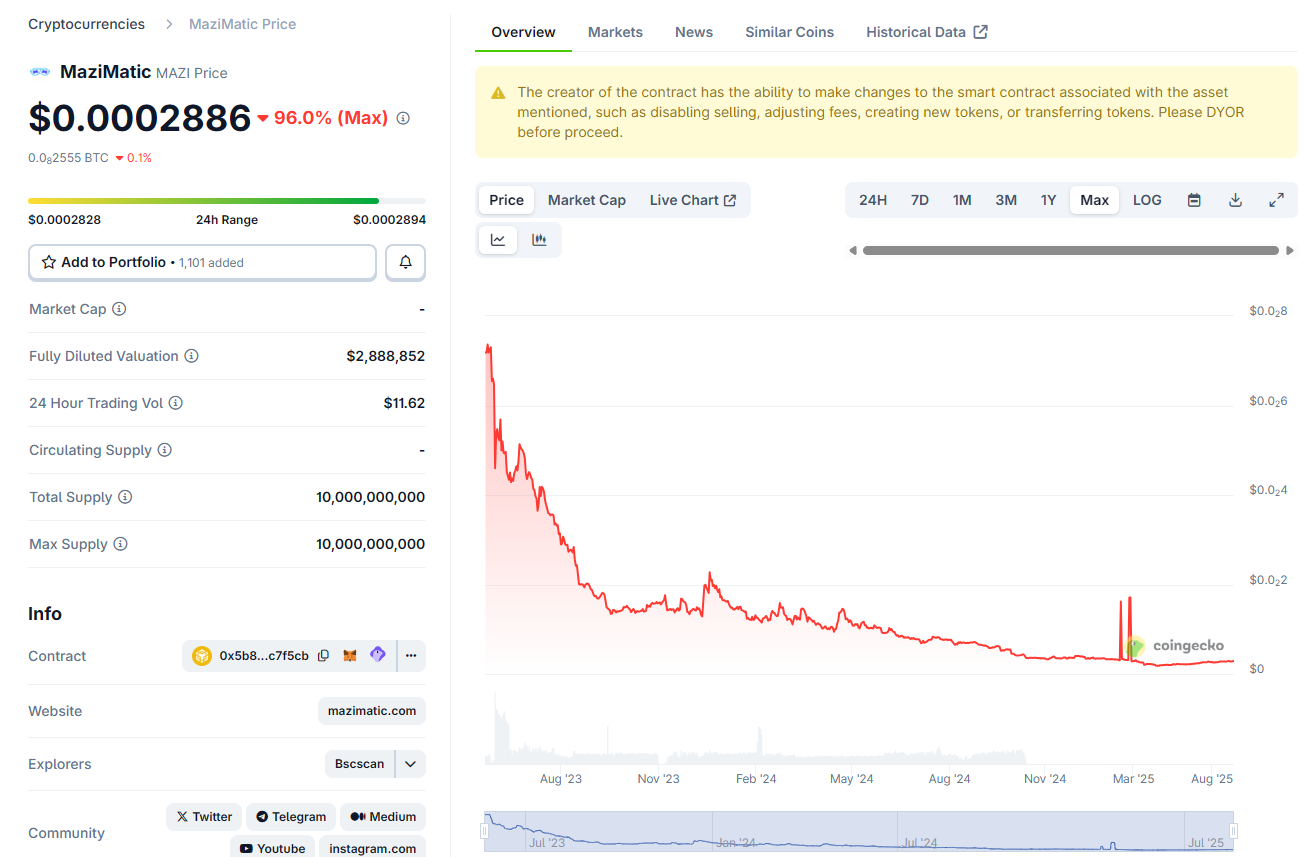
It is also worth noting that Mazi Finance belongs to the same company that previously launched the cryptocurrency project MaziMatic, tied to the metaverse industry. In 2023, the company released its own token, MaziMatic (MAZI), which was promoted as “the future of virtual entertainment and investment”. However, reality turned out to be harsh: since its launch, the token’s price has collapsed by more than 96%, the project stopped developing, and investor interest has disappeared. Now, the same company has decided to rebrand itself as a “brokerage firm”. This clearly shows that the owners have no long-term strategy — they are simply looking for new ways to profit from people’s trust.
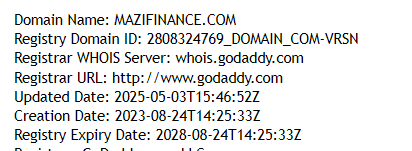
Another important point is operating history. On the website, one can find claims of “many years of experience”, but the facts tell a different story. The domain mazifinance.com was registered only in 2023. The first snapshots in the web archive date back to 2024, meaning actual activity started very recently. This is a very short period for a broker that claims international status. Serious companies develop over the years, undergo audits, obtain licenses, and build a reputation. Mazi Finance has none of this.
There are very few reviews of Mazi Finance online, which is not surprising. The broker is not popular, and no one wants to risk their money by trusting an obscure offshore company.
Moreover, half of the comments are positive reviews. However, they consist of just one or two sentences saying how profitable, reliable, and wonderful the broker supposedly is. There is no doubt these are attempts to boost reputation through fake positive feedback.
In conclusion, it can be stated directly: Mazi Finance is a typical example of a short-lived offshore broker. Its trading conditions are questionable, it has no regulation, and its owners are already known for a failed crypto project. All of this shows the company is not focused on client results. Here, only the broker wins, while traders risk losing everything.