

The company claims a legal address in Saint Lucia but also states that it is regulated by MISA, which is a Mohéli jurisdiction. This discrepancy is suspicious. Most likely, we are dealing with yet another anonymous scam, which is why the goal of this BigMarkets review is to determine whether this is true or not.
At first glance, the BigMarkets website tries to present itself as a “tech-advanced” broker: gradients, neon purple-blue colors, and large images of phones and tablets. However, the purpose of these elements is simply to attract the attention of inexperienced traders.
The top menu contains a standard set of items, yet the important About Us and Contact sections are moved down to the footer:
At the bottom of the page (the footer), there is only a minimal amount of legally significant information: the jurisdiction, the regulator (offshore), a financial advisory disclaimer, and payment system logos.
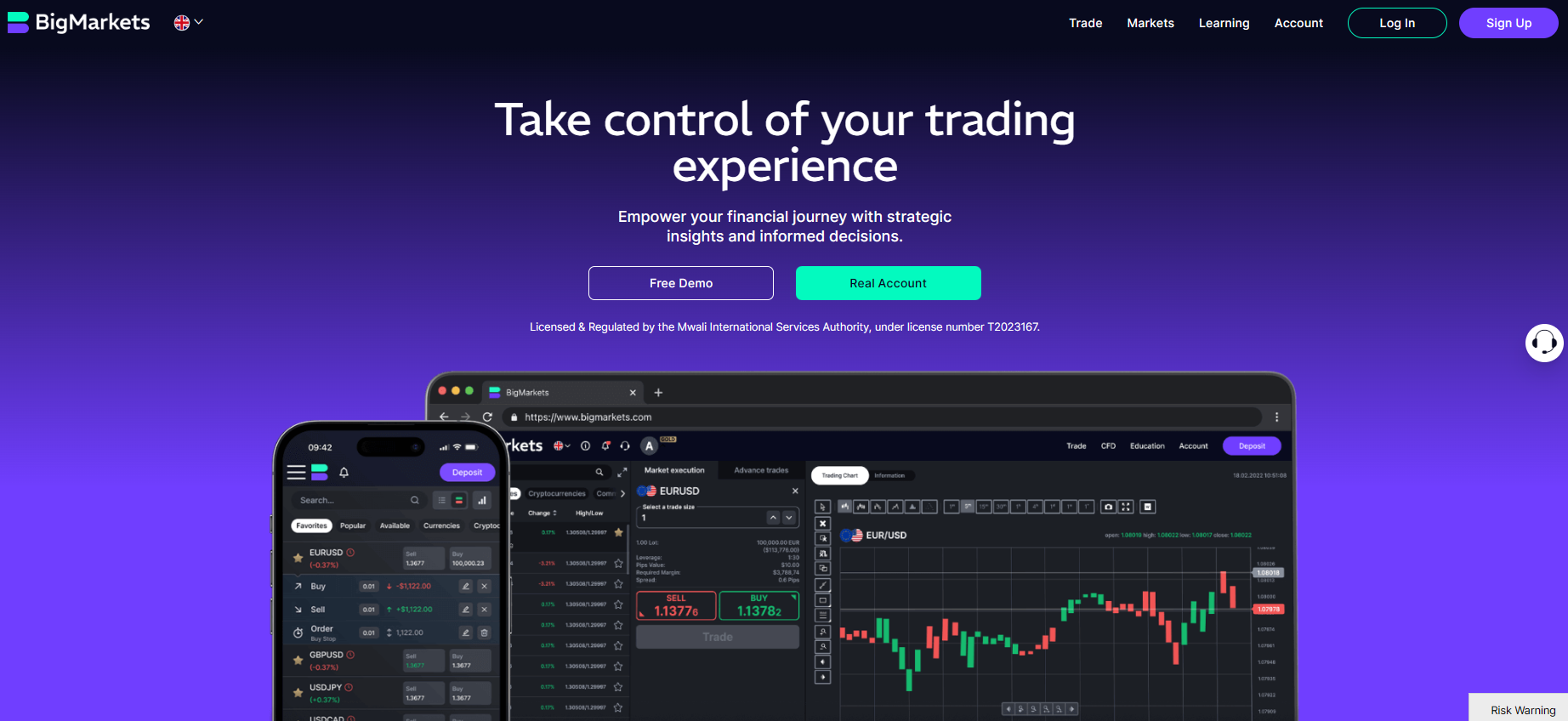
The texts on the website are generic and meaningless:
Not a single factual statement appears anywhere: no names of owners, no FCA or CySEC-level regulators, no company history, no reports, no partner banks, and no public information about liquidity, execution, or audits.
In layout, visual style, and structure, the site is almost identical to numerous other offshore brokers. It is worth noting that the structure, template, menu, and overall style of BigMarkets are extremely similar to the website of another broker, Fxonet Ltd. These are clearly two identical projects.
BigMarkets offers basic communication channels with its managers. The phone number begins with the Puerto Rico country code (+1-787), which already breaks all logic — the company claims to be registered in Saint Lucia and “regulated” by Mohéli, yet uses a number from an entirely different country. There is only one email address for all inquiries. A live-chat button is available on the right side of the page.
However, there are no links to social media accounts and no support through messaging apps. Every modern broker provides both.
The trading conditions are typical for most illegal companies. The company offers four account types, each with a different minimum deposit:
The better the account tier, the more favorable the spreads. On the basic account, spreads start at 3 pips, while on the highest tier, they start at 1.6. In other words, conditions improve with account level, but traders must deposit more money. The company also promises more free withdrawals for higher-tier accounts. This is extortion. If you want better conditions — pay more.
Commissions are not listed, which strongly suggests a 100% B-Book business model, where client trades are not routed to liquidity providers but are instead handled internally by the platform. This creates a direct conflict of interest. Traders need to profit, but when they do, the company loses. BigMarkets is directly interested in client losses.
The leverage of 1:400 is standard for offshore platforms. The company also promises fast execution and a set of additional features:
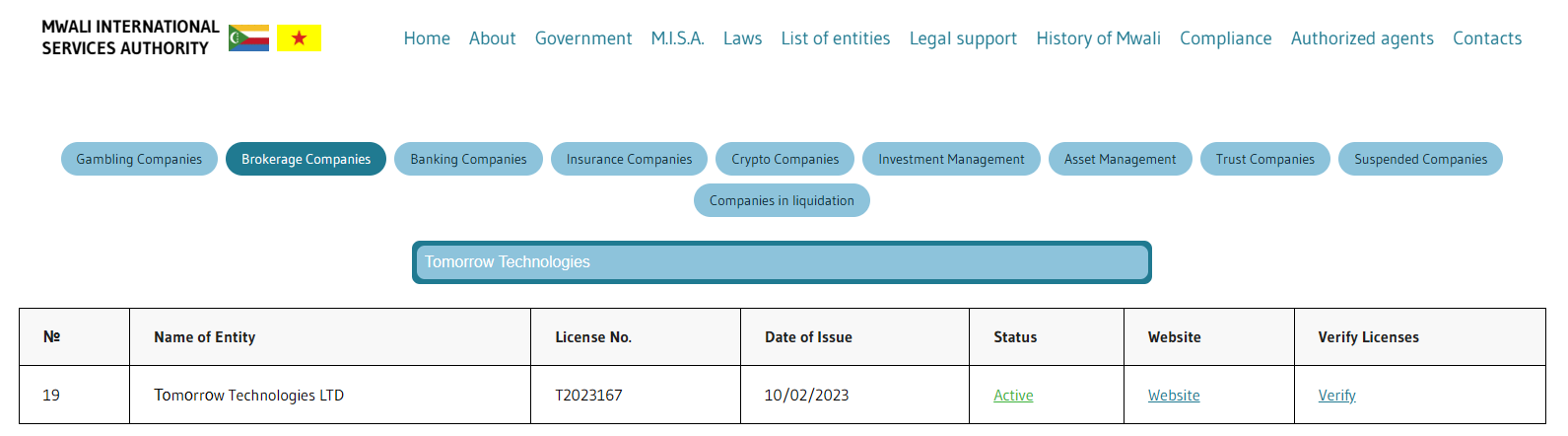
We checked the Mwali International Services Authority registry, and indeed, the company Tomorrow Technologies LTD with license number T2023167 is listed there. This is where the positive part ends.
Regulation under Mohéli is not client protection — it is a formality offshore companies purchase for appearances. This “regulator” does not monitor trade execution, does not review financial statements, does not require audits, does not oversee fund custody, and does not coordinate with any international supervisory institutions.
If the broker breaks rules, raises fees, blocks withdrawals, or disappears, the trader is left completely alone. There is no insurance fund, no compensation program, and no mandatory capital reserves. For a broker, this jurisdiction is paradise. For a trader, it is a massive red flag because disputes cannot be resolved anywhere or with anyone.
According to the official Mohéli registry, Tomorrow Technologies LTD received its license on February 10, 2023. This means the company is only two years old. For a broker, this is an extremely short lifespan. Reliable platforms operate for decades, survive crises, show stability, and publish reports. BigMarkets has no historical foundation, has not been tested by time, and has proven no resilience in any market cycle. A young offshore broker with a short history is always a high risk because there is no data on how it behaves during stress, volatility, or mass withdrawals.
An additional red flag is the absence of reviews. Almost no one writes about BigMarkets online. There are no discussions on trading forums, no analyses on major platforms, no trading screenshots, and no real client stories.
All facts indicate that BigMarkets is a dangerous trading platform with no verified reputation and no oversight from any serious regulators. The company hides key information about its operations and offers conditions that benefit only itself. The client is left with no protection and no guarantees. It is better not to start trading on such a platform at all.