

Before us is yet another offshore brokerage clone that lists its legal entity in Mwali, Comoros Islands. Many high-risk and fraudulent companies prefer to register their businesses in such jurisdictions, but this provides no guarantees that clients’ funds will be safe. In today’s Proxtrend review, we will examine a company that looks far more like a fake and a scam than a secure trading platform.
The Proxtrend website gives the impression of being assembled from a template that has already been seen many times on pseudo-brokerage platforms. The structure is familiar: at the top, there are four menu sections (Trade, Markets, Learning, and Account), followed by “sales-oriented” screens with images and a list of supposed advantages, and at the bottom, a footer with legal disclaimers and a license.
Visually, it looks like the same layout that is simply “repainted” with a different color scheme and logo. This is especially noticeable given that the site closely resembles a number of other projects linked to Mwali (Comoros Islands), creating the impression that such “brokers” are mass-produced in one place using a single template.
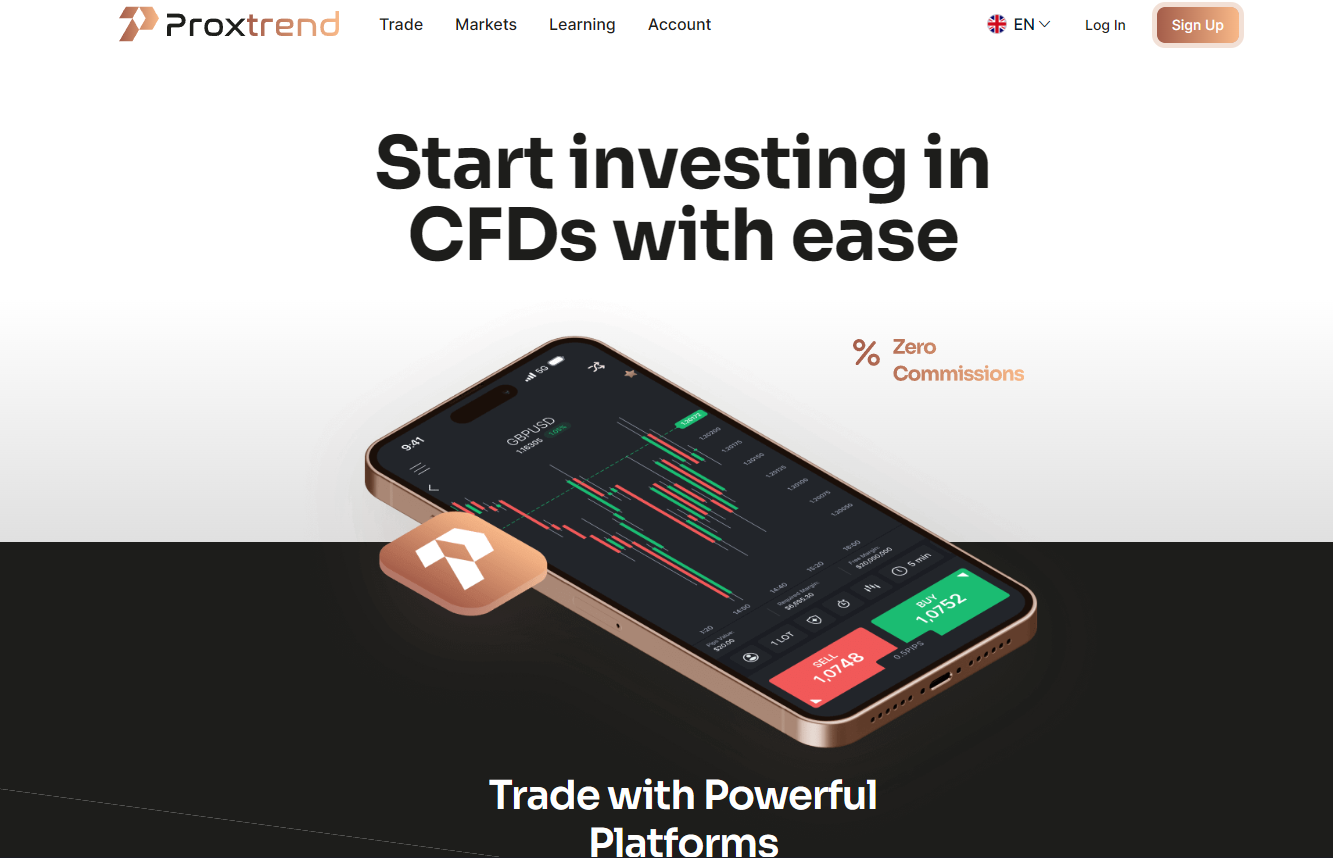
The images used are stock photos of generic characters taken from the internet (a man in a suit with a smartphone, and similar visuals), which do not inspire trust and do nothing to prove the existence of a real company infrastructure. Proxtrend makes extensive use of unnecessary and cluttering elements (a phone with charts, large Buy/Sell buttons, and “Zero commissions” badges), which create the illusion of a “dream mobile trading experience”, but in reality are merely decorations rather than evidence of execution quality, liquidity, or genuine trading conditions.
The textual content is a collection of pseudo-motivational phrases that sound appealing but provide almost no useful information to traders:
Such statements do not disclose execution conditions, the commission model, or actual trading parameters. In essence, this is “inspirational noise” used to replace concrete details.
On the official Proxtrend website, there is almost none of the information that typically distinguishes a full-fledged and transparent broker from a fraudulent project. The company does not specify its actual operating history: there is no clear launch history, no development milestones, no confirmed start dates, or even a basic timeline. Information about the founders and the team is completely absent. The business model is also not disclosed — there is no explanation of how client trades are executed, whether an A-book, B-book, or a hybrid model is used, or who acts as the counterparty.
Proxtrend’s contact details clearly do not match the level of a company that presents itself as an international broker. The website lists only one phone number and one email address, along with an online chat button. There are no additional communication channels that have long been considered industry standard: no official social media pages and no support via popular messaging apps.
The practical availability of customer support also raises concerns. The online chat, which is formally presented as a channel for prompt assistance, often fails to perform its function in practice: messages are either left unanswered or responses are significantly delayed. This creates the impression of a nominal support presence “for appearances only”, rather than a genuinely functioning service. In the event of urgent issues related to an account, trades, or withdrawals, such a communication model can become a serious problem for clients.
Proxtrend’s trading conditions are structured according to a classic scheme typical of questionable and outright fraudulent brokers. Clients are offered several account types, and the logic is extremely simple: the “better” the account, the more money must be deposited. At the same time, it is precisely on the more expensive accounts that the conditions become more favorable — lower spreads, fewer restrictions, and more “privileges”. In essence, clients are deliberately pushed to increase their deposits under a simple and dangerous message: if you want to trade properly, you must pay more. This is not about improving the quality of service, but about the basic extraction of funds, where trading conditions are used as a tool of pressure on the investor.
Looking at the spreads, they are initially inflated at the basic level. For standard currency pairs, values of around three pips or higher are stated, which already makes trading unprofitable for most strategies. As the account tier increases, the spreads gradually “improve”, but such differentiation only highlights the artificial nature of the conditions: instead of offering fair market parameters, the company sells “access to normal numbers” in exchange for a higher deposit. This is yet another marker of a pseudo-broker rather than a trading platform focused on client results.
The commission structure is even less transparent. Despite marketing claims of “zero commissions”, Proxtrend does not provide a clear and unambiguous description of all fees. It does not disclose how exactly the company earns its revenue, what commissions may be charged for trading, currency conversion, account maintenance, or withdrawals. As a result, the trader effectively agrees to the terms blindly, learning about the real costs only after the fact.
Leverage is advertised at up to 1:400 for all account types. Such a level of leverage is, in itself, a serious risk factor and is more commonly found on offshore and weakly regulated platforms. When combined with Contracts for Difference, this creates an extremely aggressive trading environment where losses can occur instantly, and responsibility is fully shifted onto the client through standard risk disclaimers.
Additional services and “benefits” are presented in a purely formal manner. Proxtrend lists analytics, an economic calendar, market reviews, education, a demo account, and so on. However, these labels are not followed by any substantive description. There is no explanation of who prepares the analytics, how often it is updated, what its quality is, what exactly the educational materials include, or how they differ across account types. In essence, this is simply a list of buzzwords without substance, used as a marketing wrapper rather than as real functionality for traders.
The company raises well-founded suspicions from the very first stage. A template-based website, vague descriptions of trading conditions, account types typical of scams, and a lack of transparent information — all of this is characteristic of pseudo-brokers. In such cases, it is logical to move from surface-level assessment to fact-checking: licenses, legal data, and the actual length of operation, in order to determine whether this is a legitimate broker or yet another imitation of a brokerage company.
When checking the license, it turns out that a company with the legal name Proxtrend Ltd and license BFX2024053 is indeed listed in the registry of the Mwali International Services Authority. Formally, the entry is active; however, a key inconsistency arises here. The registry lists proxtrendltd.com as the official website, while the promoted brokerage platform operates under the domain proxtrend.com. This raises a serious question: why does what is supposedly the same company have different websites, and which one is actually linked to the license. Such discrepancies are often encountered in schemes where third-party data or formally registered details are used to create an illusion of legitimacy and to “shield” operations behind an existing offshore registry entry.
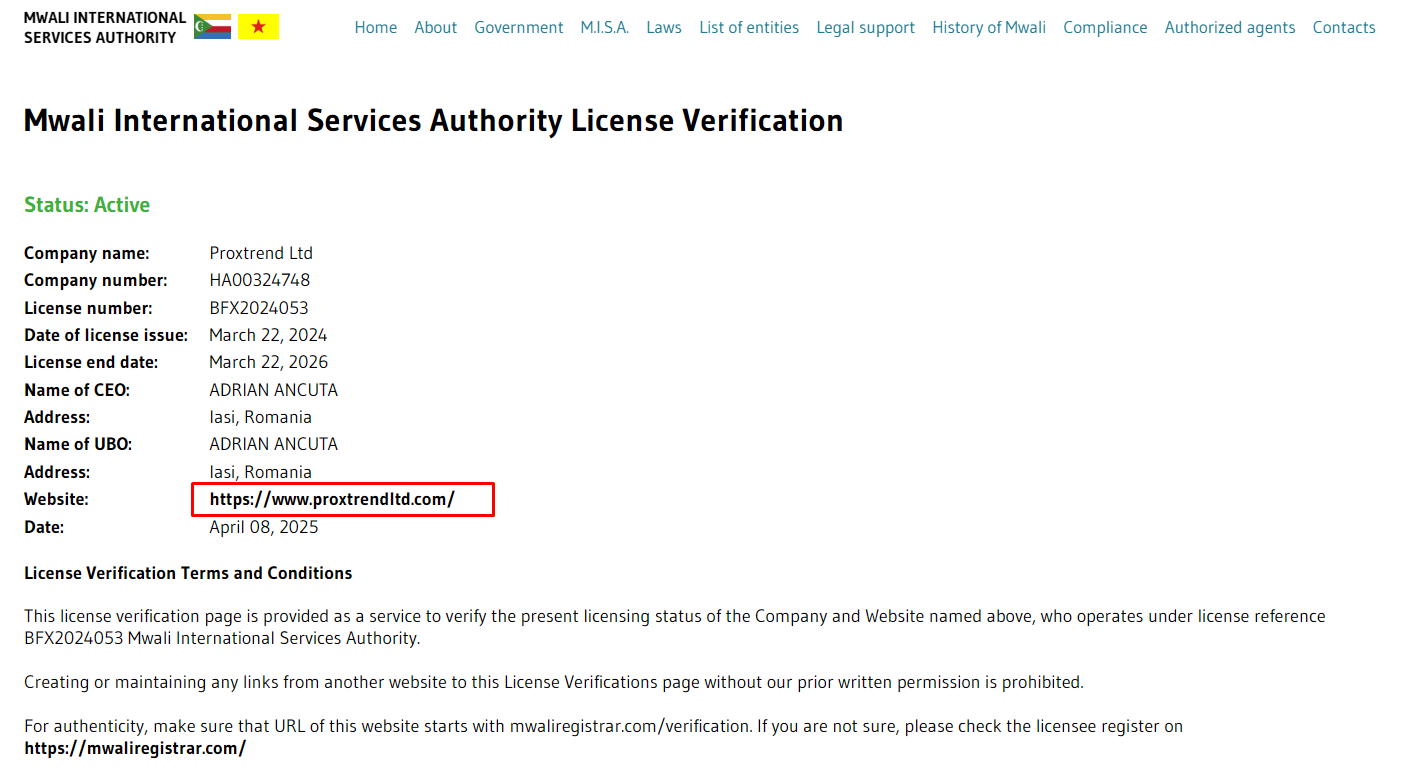
Even if one assumes that, legally, this refers to the same entity, regulation through MISA in itself does not provide clients with real guarantees. The Mwali regulator is not considered an authoritative supervisory body and does not ensure strict oversight of brokers’ activities, investor protection, or effective dispute resolution mechanisms. Such a license is easy to obtain, requires minimal financial transparency, and effectively does not protect the trader in the event of a conflict or loss of funds. This is precisely why such “regulation” is considered a red flag and is often used by offshore and problematic projects.
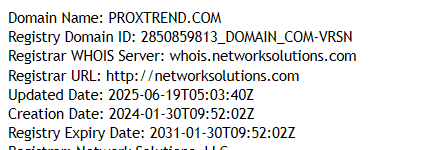
An additional red flag is the length of the operation. The domain proxtrend.com was registered only in 2024, which completely undermines any hints of experience or an “established business”. The company has not stood the test of time, has no confirmed reputation, and does not demonstrate a long-term history in the financial markets. For brokerage activity, especially in the Contracts for Difference segment, this is a serious drawback: the absence of a track record means elevated risks and zero confidence that the project will continue to exist and fulfill its obligations in the future.
Online reviews of Proxtrend appear mixed, but their overall tone cannot be described as positive: the company’s average rating falls below three points, which in itself is already a red flag.
On the internet, both negative and formally positive comments can be found, but there is a noticeable difference between them. In negative reviews, users describe their experiences in detail, pointing out specific problems, details of interactions with support, and difficulties with trading and withdrawals. Positive reviews, on the other hand, look superficial and template-like: they contain almost no facts, dates, amounts, or descriptions of real situations, and instead rely on generic phrases such as “everything is great”, “the best experience”, and “completely satisfied”. This contrast creates the impression of an artificially manufactured positive sentiment and further undermines trust in the company.
Proxtrend does not provide sufficient grounds to be considered a safe and reliable broker. This broker is more suitable for a list of companies that should be avoided. We do not recommend opening a brokerage account here.