

Elysian Capital positions itself as a world-class broker, displaying the logos of Citi, HSBC, Deloitte, MIT, and even Binance Labs. However, experienced traders immediately ask: where is the proof? And do they actually have licenses? The answers are simple: it is all fake. In this review, I will show why this firm looks more like a scam than a broker.
The official Elysian Capital website is far from impressive. At the top of the page, there is a standard menu: Markets, Trade, About Us, Our Team, Account Plans, and Privacy Policy. Everything looks as if the designer simply assembled a cheap template with a website builder. The menu is empty and offers nothing of real value to clients. One of the first red flags is the absence of a “Contacts” section.
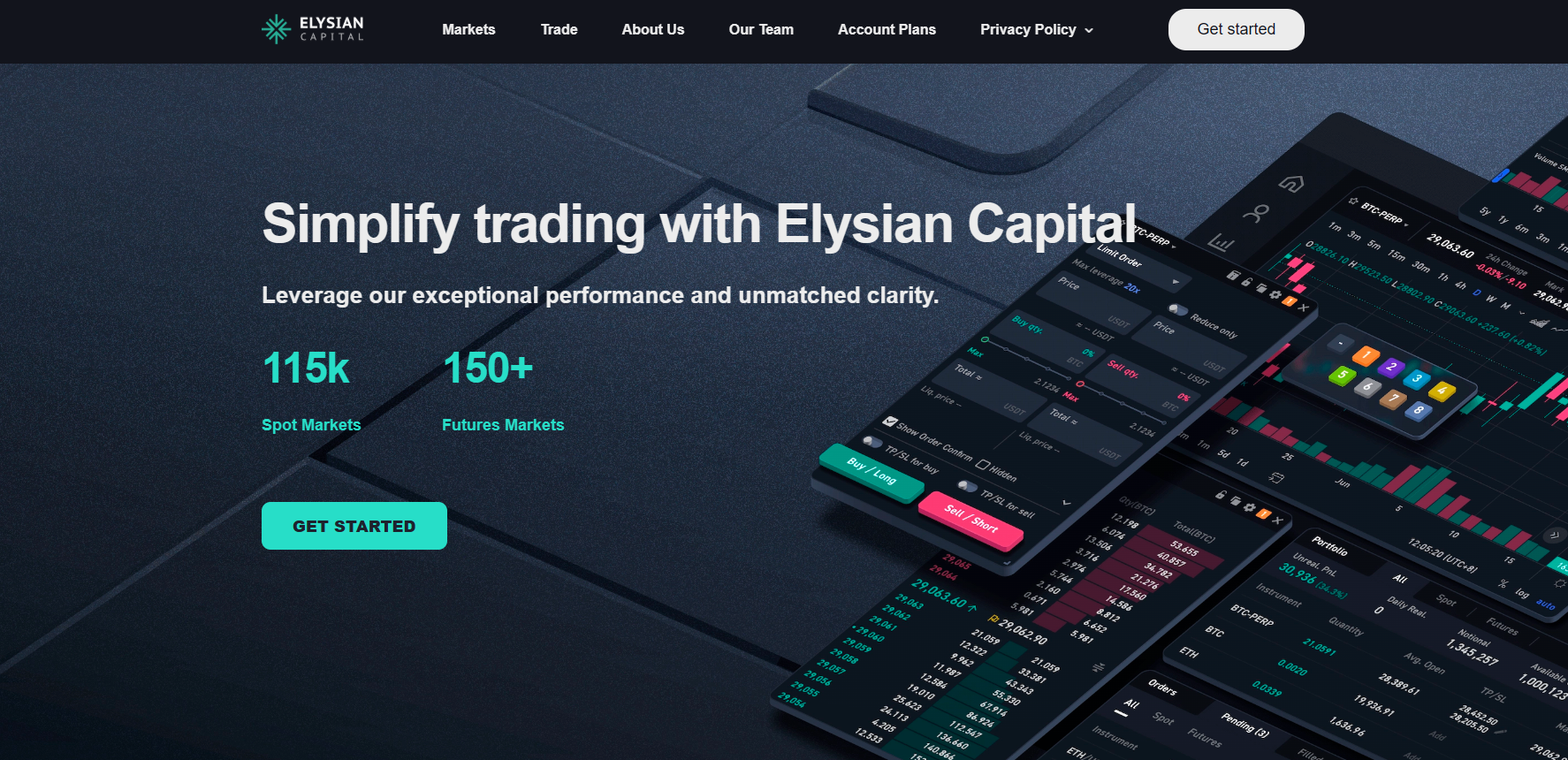
There is no information about Elysian Capital itself at all. You will not find details about its founding date, time in the market, business model, or management. There is not even a minimal section with company history, something real brokers love to highlight. The only element intended to inspire trust is a block with “licenses”. However, this regulation requires closer scrutiny, which we will get to later.
The legal framework of Elysian Capital raises more questions than answers. The website only contains a few documents: AML/KYC policy, refund policy, and privacy policy. But the main document, the user agreement, is simply missing. There are also no trading rules, risk disclosures, terms of client services, or other mandatory files. For a broker, this is critical: without such documents, a company has no legal right to work with client funds.
The website design is cheap and primitive. The images are clearly taken from the internet. The content also raises concerns. The texts are filled with generic phrases, plenty of fluff, and almost no substance. Readers are asked to take on faith claims of “zero commissions” and “115k markets”. For comparison, even the largest global exchanges do not offer such numbers. If a broker promises more than the industry leaders, it is an immediate sign of fraud.
In the end, the Elysian Capital website leaves an extremely negative impression. No contacts, no legal address, no transparent conditions, and no real documents.
As already mentioned, the section with contact details is simply missing. Even in the footer, Elysian Capital does not list a phone number or an email address. There is no live chat, no messenger accounts, and no social media presence. The company clearly does not want traders to contact them.
Elysian Capital builds everything around account plans. The company offers six different types of accounts. The logic is simple: the larger the deposit, the more “privileges”. To gain access to better conditions, a trader must constantly increase their deposit amount. This approach is often used by fraudulent projects — it is designed to extract as much money from clients as possible.
The minimum deposit starts at $250. From there, the thresholds rise sharply: several thousand for “Gold”, tens of thousands for “Platinum”, and up to one million dollars for the top-tier account. Leverage begins at 1:10 on the lowest package and reaches 1:100 on the highest, although it should be the opposite. Why would traders with large capital need high leverage? Leverage is necessary for those with small deposits. Elysian Capital fully understands that the higher the leverage, the easier it is to lose money.
Trading commissions are not disclosed either. The website only mentions a 5% commission on profits under certain plans. For a brokerage business, this is absurd. Such a rule does not exist in the industry: traders pay either a fixed spread or a commission per lot, but never a percentage of profit. This is a clear sign of a fraudulent scheme.
The “extra services” also deserve attention. Expensive plans promise a “personal financial advisor”, “risk-free trades”, and “signals”. These perks are not meant to help the trader, but to convince them to deposit more money. In reality, such “advisors” usually push risky trades that lead to account wipeouts.
In the end, Elysian Capital’s trading conditions are not designed for real work but as a pressure tool against clients. There are no transparent parameters or contract specifications. Instead, there is a fraudulent scheme with account plans that force clients to deposit larger sums, along with dubious services that make traders entirely dependent on the company’s “managers”.
The company raised red flags from the start. Its website does not provide a legal address, registration number, or any specifics about where it is registered. There is no indication of where the firm is based, in which country it operates, or under which jurisdiction it conducts business. For a broker, this is critical: legitimate companies always disclose such details, as client trust depends on them. Here, we are faced with nothing but emptiness — a clear sign the firm does not want to reveal its true nature.
At the same time, the website proudly displays “licenses”. At first glance, it may seem that Elysian Capital is regulated by European and Australian authorities. However, if you follow the links, for example, fina-eu.elysian-capital.com or fin-au.elysian-capital.com, it becomes obvious these are fictional entities. They list supposed registration numbers — HE547256 and AUSF 912 572. The problem is, such regulators simply do not exist. In Europe, oversight is carried out by the FCA (United Kingdom), CySEC (Cyprus), or BaFin (Germany). In Australia, it is ASIC. There is no such thing as the “European Financial Authority” or “Australian Financial Security”. This means the licenses are fake, drawn up just for show.
Special attention should also be paid to the domain’s age. The site elysian-capital.com was registered in April 2025, just a few months ago. The company does not even have one year of operating history. This is why they avoided mentioning their founding date on the website — it would expose them instantly. In the brokerage industry, the length of time a company has existed is extremely important: the longer it has been in the market, the greater the trust. Here, it is obvious this project was only recently created and is already disguising itself as a major player.

There are almost no reviews about Elysian Capital — fewer than ten mentions can be found online, which is hardly surprising. The company has existed for only a few months, hides behind fake licenses, and discloses no legal information. It has neither an established track record nor a reputation, so users simply have not had time to leave feedback. For a broker, this is a serious drawback: legitimate platforms with real experience always have hundreds or even thousands of reviews on forums and independent websites.
All the facts speak for themselves: no proper documents, fictitious licenses, minimal operating history, and questionable trading conditions. This is a typical scam project disguised as a broker. Elysian Capital cannot be trusted.